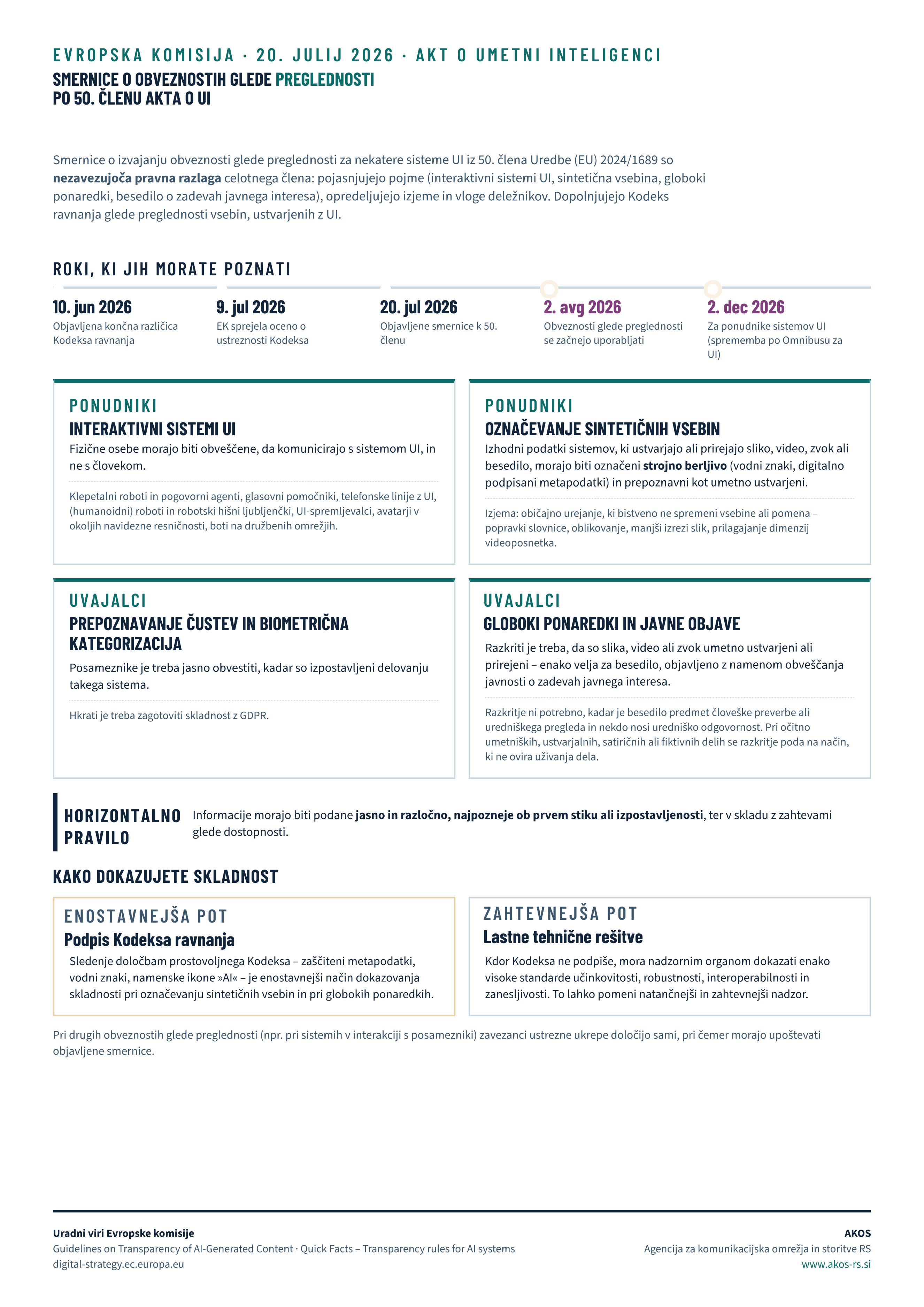
On 20 July 2026, the European Commission (EC) published Guidelines on the implementation of transparency obligations for certain artificial intelligence (hereinafter: AI) systems under Article 50 of Regulation (EU) 2024/1689, i.e. the Artificial Intelligence Act (Guidelines on the implementation of the transparency obligations for certain AI systems under Article 50 of Regulation (EU) 2024/1689). The document is important for providers and operators of artificial intelligence (AI) systems, as well as for competent authorities, as it assists them in ensuring compliance with the transparency obligations set out in Article 50 of the Artificial Intelligence Act (the AI Act), which comes into force on 2 August 2026.
The guidelines complementthe Code of Practice on Transparency of AI-generated content( hereinafter the ‘Code of Practice’), the final version of which was published on 10 June 2026 and for which the European Commission (EC) also adopted an adequacy assessment on 9 July 2026 (more on this on the AKOS website). The Code of Practice addresses the technical and practical aspects of implementing the obligations for providers and operators of AI systems set out in Article 50(2), (4) and (5) of the AI Act, whilst the guidelines cover Article 50 of the AI Act in its entirety.
The purpose of the guidelines is to provide providers and operators of UI systems, as well as the competent authorities, with practical guidance for a uniform understanding and effective implementation of the transparency obligations relating to specific UI systems, as prescribed by Article 50 of the UI Act.
The guidelines constitute a non-binding legal interpretation of Article 50 of the AI Act in its entirety and primarily contain explanations of legal concepts (e.g. directly interactive AI systems, synthetic content, deepfakes, text on matters of public interest) and set out exceptions, such as the normal editing of content. Furthermore, they clarify the role of stakeholders and address the protection of individuals’ rights. They are intended for all supervisory authorities, providers and implementers of AI systems, courts and other stakeholders to assist in the interpretation of obligations. These are practical guidelines for the consistent, effective and uniform implementation and understanding of the obligations.
The transparency obligations will come into force as early as 2 August 2026, except for AI system providers, for whom the rules will apply from 2 December 2026 (in line with the amendments to the AI Act introduced by the AI Omnibus). The document sets out in more detail the four main pillars of the obligations and the horizontal rules:
Interactive AI systems: Providers of AI systems that communicate directly with natural persons must ensure that natural persons are informed that they are communicating with an AI system (e.g. AI-powered voice assistants, chatbots or conversational agents in various contexts, AI-powered telephone helplines, (humanoid) robots, AI companions, robotic pets, AI-powered avatars (e.g. in virtual reality environments), and AI bots on social networks and media).
Labelling of synthetic content: this concerns the obligations of AI system providers that create or modify synthetic content, such as image, video, audio or text content, to ensure that the output data is labelled in a machine-readable format (e.g. watermarks, digitally signed metadata) and that such outputs are also identifiable as artificially created or manipulated. The guidelines also clarify the scope of exceptions, specifying when standard content editing (e.g. correcting grammar, formatting that does not alter the content or meaning of the input data, minor cropping of images, adjusting video dimensions, etc.) or in cases where the AI system does not substantially alter the content and meaning of the input data.
Emotion recognition and biometric categorisation: Operators of AI systems for emotion recognition and biometric categorisation must clearly inform individuals when they are subject to the operation of these systems and, of course, ensure compliance with the GDPR.
Deepfakes and public publications: Implementers of AI systems that create or manipulate content constituting deepfakes (images, video, audio) or publish text intended to inform the public about matters of public interest must disclose that this content has been artificially created or altered. The guidelines provide examples of when content constitutes a deepfake and when it does not, and when matters of public interest are involved in the creation of text intended to inform the public (e.g. matters relating to public services, consumer protection, democratic processes, fundamental rights) and when text generated by AI does not need to be disclosed (if it is subject to human verification or editorial review, and where a natural or legal person bears editorial responsibility for the publication of the content) and the conditions for this. The guidelines also clarify when an exception applies to content that forms part of a clearly artistic, creative, satirical, fictional or similar work or programme (where transparency obligations are limited to disclosing the existence of such created or adapted content in an appropriate manner that does not hinder the display or enjoyment of the work) and when such an exception does not apply.
Horizontal rules: Information must be provided in a clear and distinct manner no later than at the time of first contact or exposure, and in accordance with accessibility requirements.
Demonstrating compliance in practice
The guidelines also explain how providers and implementers can demonstrate compliance with their legal obligations to supervisory authorities.
Providers and implementers of AI systems can demonstrate compliance with points 2 and 4 above by adopting and adhering to the provisions of the voluntary Code of Practice. Adherence to the provisions of the Code (e.g. the use of protected metadata, watermarks or dedicated ‘AI’ icons) will serve as a simpler way of demonstrating compliance.
However, those data controllers who decide not to sign the Code, and do not intend to do so, will have to demonstrate compliance to supervisory authorities through their own technical solutions. These solutions will have to meet equally high standards of effectiveness, robustness, interoperability and reliability, which may consequently result in more detailed and rigorous supervision by the competent authorities.
With regard to other transparency obligations (e.g. concerning systems that interact with individuals), data controllers may determine the appropriate measures themselves, whilst taking into account the published Guidelines.
Useful links and resources
For a more detailed insight into the rules and technical requirements, official documents from the European Commission are available:
- Published guidelines: Guidelines on Transparency of AI-Generated Content
- Key facts at a glance: Quick Facts – Transparency rules for AI systems
