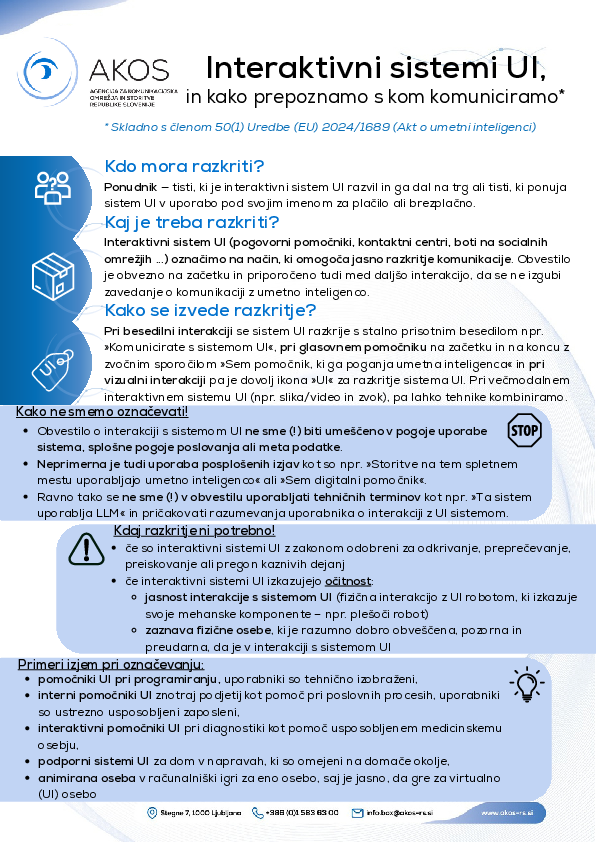
On 20 July 2026, the European Commission (EC) officially published the Guidelines on the implementation of transparency obligations for certain artificial intelligence (hereinafter: AI) systems under Article 50 of Regulation (EU) 2024/1689, i.e. the Artificial Intelligence Act (Guidelines on the implementation of the transparency obligations for certain AI systems under Article 50 of Regulation (EU) 2024/1689, hereinafter: the Guidelines). This document is of key importance to providers and deployers of artificial intelligence systems, as well as to competent authorities, as it assists them in ensuring compliance with the transparency obligations set out in Article 50 of the Artificial Intelligence Act (the AI Act), which enters into force on 2 August 2026.
The Agency explains below how providers of AI systems must ensure compliance with the transparency obligations for interactive AI systems that interact directly with natural persons, as set out in the first paragraph of Article 50 of the AI Act.
Howdo we identify an interactive AI system?
An interactive AI system must meet four key conditions:
an interactive AI system is an AI system, as determined in accordance with the definition of an AI system (Article 3(1) of the AI Act and the Commission Guidelines on the definition of an artificial intelligence system),
the AI system is intended to interact with a natural person,
communication between the AI system and a natural person is direct,
the AI system must be interacting with a natural person.
AI agents capable of interacting with natural persons are also considered to be interactive AI systems.
What are the disclosure obligations for an interactive UI system?
An AI system that is found to be an interactive AI system is also subject to disclosure obligations regarding the interaction itself. Providers of such systems must ensure that UI systems which interact directly with natural persons are developed and designed in such a way as to adequately inform the natural person that they are communicating with a UI system. Information regarding interaction with the AI system must be:
provided upon the first interaction with or exposure to the interactive AI system;
the content of the notification must be clear and unambiguous, and must clearly indicate that an interaction with the AI system is taking place. The notification must meet accessibility requirements (so that they can be recognised even by people with disabilities) and adapted to the characteristics and needs of different user groups (e.g. minors, older people, or people with lower levels of digital literacy);
it is recommended that the notification be repeated several times during the course of use. This is particularly important for vulnerable user groups, who are more likely to lose awareness that they are interacting with the UI system during prolonged use.
When a user asks whether the system is a UI, or what the nature of their interaction is, the UI must clearly disclose this information.
How should the user be informed about their interaction with the UI system?
The format of the notification must be adapted to the manner in which the UI system interacts with the user. The notification may be a combination of several techniques to reinforce the recipients’ understanding, depending on the context and the target and intended audience. The guidelines cite the following as appropriate techniques or methods:
disclosure via a clear text message in the case of text-based interaction (e.g. ‘You are communicating with the UI system’ or ‘You are interacting with an AI system’), whilst additional labels or tags that accompany the interaction (taking into account the context of use and the risks of the interaction) and are located close to the communication interface are also recommended;
disclosure via a clear audio message in the case of audio interaction (e.g. the audio message ‘This is an AI-powered assistant’ or ‘I am an AI-powered assistant’) and repeated periodically during longer interactions. For people with visual impairments, an audio icon – such as an Earcon – may also be included;
disclosure via a clearly recognisable label or icon in the case of visual interaction (cues), e.g. ‘AI’ or ‘UI’, which is the easiest way to reveal the artificial intelligence nature of the UI system (e.g. an email sent by the UI system, a standardised indicator across all the provider’s services);
disclosure using a combinationof the techniques listed above in the case of multimodal interaction (e.g. image/video and sound), all with the aim of making it as easy as possible to recognise interaction with the UI system.
When is disclosure insufficient?
When communicating information about interaction with the UI system, we must avoid superficial or indirect methods of communication that obscure the true nature of the interaction. The following are considered inappropriate:
a notification regarding communication with the UI system embedded within the app’s terms of use, general terms and conditions, or a notification embedded in metadata or watermarks. It is also inappropriate to provide information using vague and ambiguous signals that resemble human behaviour and mislead users.
the use of generalised statements (e.g. ‘The services on this website use artificial intelligence’, ‘I am a digital assistant’) or using technical terms in the notification (e.g. ‘This system uses an LLM’) whilst expecting users to understand how to interact with the system’s UI.
When is disclosure not required?
In certain cases, it is not necessary to inform the user that they are communicating with an AI system. This applies to AI systems that are legally authorised systems for the detection, prevention, investigation or prosecution of criminal offences. These systems are exempt from the disclosure requirement, the aim being to conceal their nature and thereby prevent criminal offences. However, this exemption does not apply to interactive AI systems that are available to the public for reporting criminal offences. Such examples include AI assistants on telephone helplines, AI assistants for reporting financial fraud, or virtual AI assistants for gathering information or statements from victims and witnesses.
Similarly, there is no need to inform the user that they are interacting with an AI system if the interaction with the AI system is obvious.
Obviousness is demonstrated in two ways:
- the clarity of the interaction with the AI system (e.g. physical interaction with an AI robot that displays its mechanical components – e.g. a dancing robot), through voice communication (which reveals a robotic voice) or through its animation, where its non-human nature is clearly recognisable),
- it is perceived by a physical person who is reasonably well-informed, attentive and judicious whilst interacting with the UI system. In this regard, it is necessary to determine:
- who the potential audience for this interaction might be (e.g. older people, people with disabilities, minors, etc. – it is assumed that these groups are also included if the system is generally accessible) and
- whether, from the perspective of such a person or group, this interaction is obvious, given the circumstances and context of use.
As an example, we can cite the use of an interactive UI system at an educational event or a specialist technical conference, where it is generally not necessary to specifically inform the audience, if it is clear that participants understand they are communicating with the UI system. Conversely, a notification is essential in the case of an event where vulnerable groups may be present, as they may quickly lose track of the nature of the communication.
Examples of exceptions when interacting with an AI system, where additional notification is generally not required if it is obvious to the user that they are communicating with an AI system, may include:
AI assistants for programming (users are technically trained and aware that they are interacting with an AI system),
internal UI assistants within organisations to support business processes (HR assistants, UI assistants for equipment procurement, legal UI advisers, IT support), where users are suitably trained staff and the nature of the UI system is clearly understood by them,
interactive AI assistants for diagnostics, assisting suitably trained medical staff,
AI support systems for the home in devices limited to the domestic environment (home AI assistant),
or an animated character in a single-player computer game, as it is clear that this is a virtual (AI) character.
However, this exception does not apply to robotic AI pets, where the resemblance to an animal is very high, or to support for the use of virtual environments (VR headsets), where the animation of the characters with whom we communicate in the virtual world closely resembles real people. In this case, notification of interaction with the UI system is mandatory.
