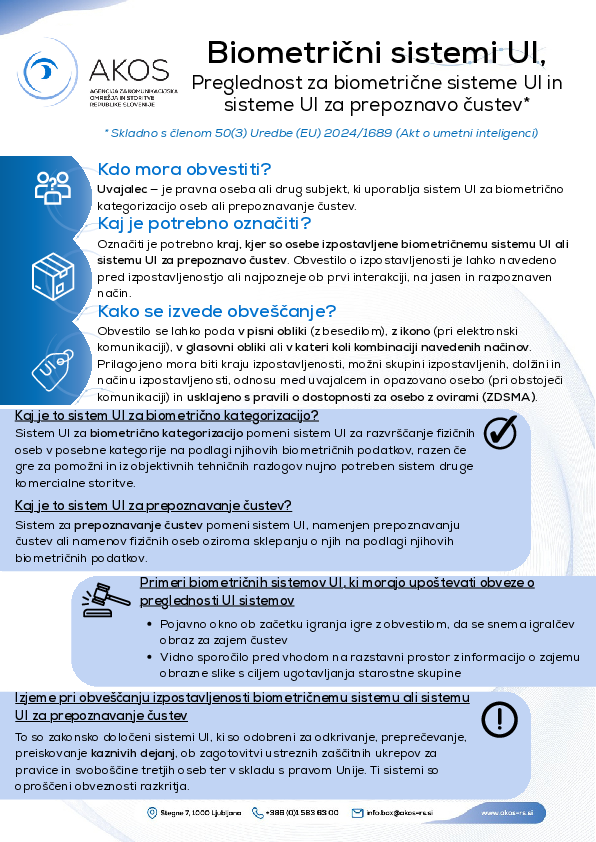
The Agency’s guidance on how implementers of AI systems for biometric categorisation and emotion recognition must ensure compliance with the notification obligations as set out in the third paragraph of Article 50 of the AI Act.
An AI system for biometric categorisation means an AI system for classifying natural persons into specific categories on the basis of their biometric data, unless it is an ancillary system of another commercial service that is strictly necessary for objective technical reasons. An example of such a biometric system is an AI system which, on the basis of an image of an individual’s face, classifies them into a specific age group.
An emotion recognition system refers to an AI system designed to recognise the emotions or intentions of natural persons, or to draw conclusions about them, on the basis of their biometric data. An example is an AI system which, by analysing a recording of a player’s face, infers their emotional state whilst playing a computer game. AI systems designed to recognise emotions are classified as high-risk AI systems under the AI Act, with the sole exception being the use of such systems in the field of education and in the workplace, where such practices are prohibited (point (f) of the first paragraph of Article 5 of the AI Act).
The operator of a biometric identification system must inform the individual of their exposure to the biometric system prior to such exposure or, at the latest, upon the first interaction, in a clear and recognisable manner. The notification must be provided in writing (in text form), via an icon (in the case of electronic communication), by voice, or by any combination thereof.
The notification itself must be tailored to:
the location of exposure to the AI system (e.g. a virtual gaming platform, a railway station),
the potential group being observed (children, older people, people with disabilities…),
the duration and nature of the exposure (prolonged, one-off, occasional, …),
the relationship between the presenter and the person being observed (e.g. whether there is already an existing line of communication with the individual) and
in accordance with accessibility rules for people with disabilities.
Under Article 50 of the Act on Biometric Identification, the operator of such a system is not obliged to inform the persons subject to monitoring of the reasons for the use of biometric identification systems, but must inform them of how the system operates. However, this does not mean that they are not obliged to do so under other rules, such as those on the protection of personal data (GDPR).
In certain cases, the obligation to provide information on the use of AI biometric systems and AI systems for emotion recognition does not apply. These are AI systems whose use is permitted by law for the detection, prevention or investigation of criminal offences, provided that appropriate safeguards for the rights and freedoms of third parties are in place and in accordance with EU law.
From 2 August 2026, new transparency obligations will apply to the use of certain AI systems. These are primarily intended to ensure that individuals are aware when they are communicating with an AI system or when certain content has been generated or modified with its assistance.
On 20 July 2026, the European Commission (EC) officially published the Guidelines on the implementation of transparency obligations for certain AI systems under Article 50 of Regulation (EU) 2024/1689, i.e. the Artificial Intelligence Act (Guidelines on the implementation of the transparency obligations for certain AI systems under Article 50 of Regulation (EU) 2024/1689). The document is of crucial importance to providers and deployers of AI systems, as well as to competent authorities, as it helps them to understand the scope of the transparency obligations and exemptions set out in Article 50 of the Artificial Intelligence Act (AI Act).
