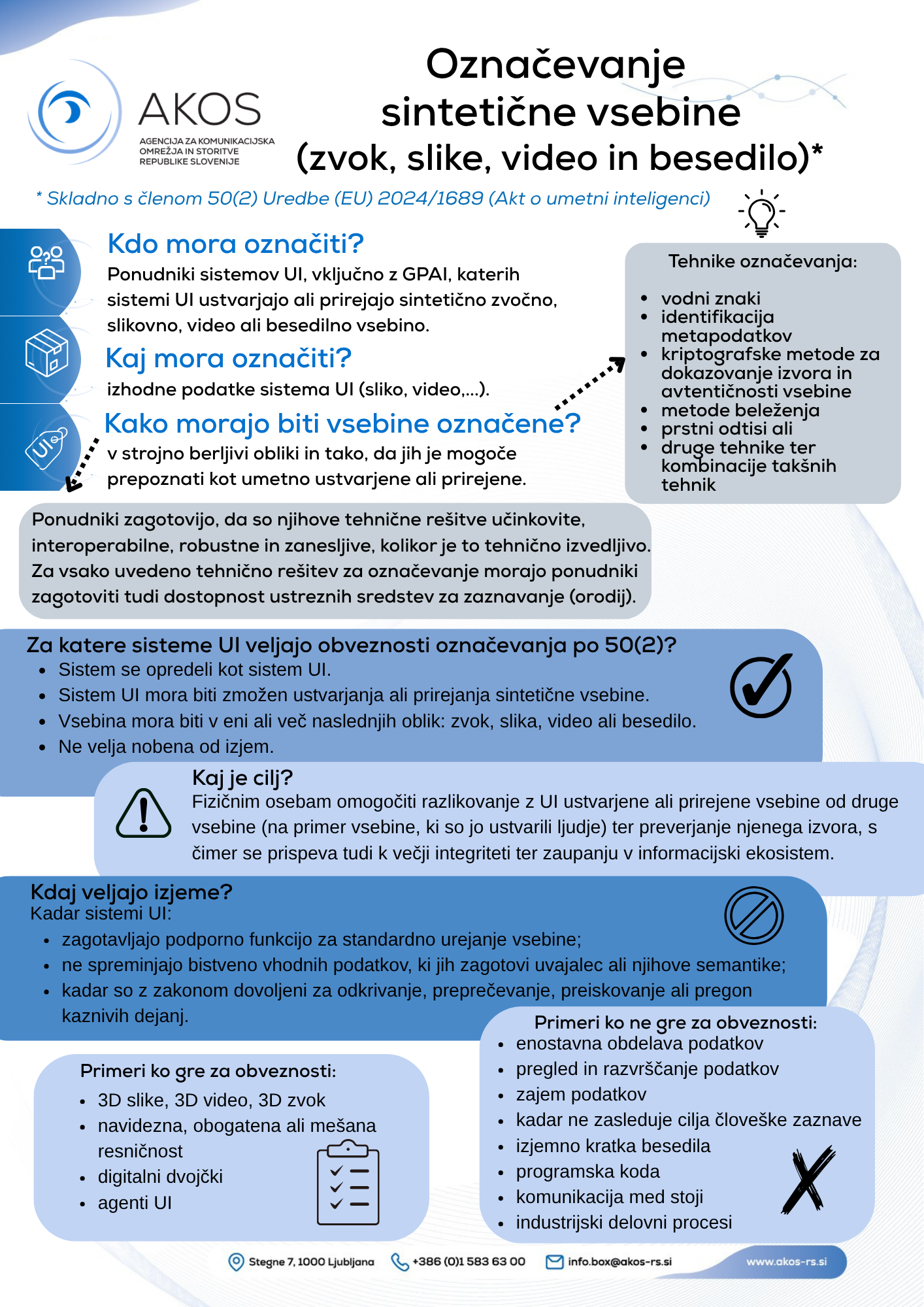
The Agency’s guidance on how providers of artificial intelligence (hereinafter: AI) systems, including general-purpose AI systems that generate synthetic audio, visual, video or text content, must ensure compliance with the obligations regarding the labelling of artificially generated or manipulated content, as set out in the second paragraph of Article 50 of the AI Act.
These obligations shall apply from 2 August 2026. A transitional period applies to providers of the aforementioned AI systems that were placed on the market prior to that date: they must ensure compliance with these obligations by 2 December 2026 at the latest.
What is the aim of labelling?
To enable individuals to distinguish content created or manipulated using AI from other content (such as content created by humans) and to verify its origin. This contributes to greater integrity and trust in the information ecosystem and helps to reduce the risks associated with disinformation, manipulation and fraud. Such labels and detection mechanisms are particularly important for individuals, regulatory bodies, the media and online platforms.
Who is required to label?
Providers whose AI systems, including general-purpose AI (GPAI) systems, generate or manipulate synthetic content (audio, images, video or text).
Content generation means that the AI system creates new synthetic content (e.g. based on a human prompt, such as the creation of a synthetic image or song).
Content adaptation means that the AI system modifies existing content, which may be synthetic or non-synthetic (e.g. an existing image or voice recording that the AI system adapts in accordance with human instructions).
To which types of AI systems does labelling apply?
All of the following conditions must be met:
the system is defined as an AI system;
the AI system must be capable of generating or adapting synthetic content;
the content must be in one or more of the following formats (modalities): audio, image, video or text;
none of the exceptions apply.
The obligations set out in Article 50(2) apply to:
generative AI systems designed with a narrow intended purpose to generate specific output;
AI systems capable of serving multiple purposes, including general-purpose AI systems capable of generating various types of content; and
agent-based AI systems, provided they generate synthetic audio, image, video or text content.
What are the exceptions?
the AI system performs a supporting function in standard content editing (e.g. minor corrections to improve readability and grammar, quality and format);
the UI system does not substantially alter the input data provided by the user or its semantics – each individual case is assessed (taking into account relevant factors such as format, type of media content, style and changes to the content that affect its meaning, style or purpose); or
the AI system is legally authorised for the detection, prevention, investigation or prosecution of criminal offences.
What must be labelled?
The provider must label the output data of the AI system (image, video, audio or text). In doing so, they must ensure that the AI system’s output is labelled in a machine-readable format and that the output is identifiable as artificially generated or modified content.
For each labelling solution implemented, tenderers must ensure the availability of appropriate means for detecting labels (tools) that enable individuals exposed to the content, and other relevant stakeholders, to recognise and distinguish AI-generated content from other content. A technical solution should be understood as a combination of labelling techniques and detection tools implemented by the provider to fulfil the transparency obligations set out in Article 50(2) of the AI Act.
Both elements (detection and labelling) must be fulfilled in order to effectively achieve the objectives of the transparency obligations set out in Article 50(2) of the AI Act. Compliance with only one element (e.g. machine-readable labelling of output data without available means for detecting it) will not suffice for compliance with this provision.
Contractors must ensure that the technical solution (for labelling and detection) used is effective, interoperable, robust and reliable, insofar as this is technically feasible.
IMPORTANT!
Content does not need to be created or adapted exclusively by AI. Content that combines material created or adapted using AI with material created by a human is also defined as synthetic content if it is adapted or created in one of the forms (modalities) set out in Article 50(2) of the AI Act (audio, image, video or text).
How is labelling carried out?
1. Labelling requirement
Labels must be in a machine-readable format, which means that they are structured in such a way that software applications can automatically recognise, read and process them without human intervention. Suppliers may rely on a single labelling technique or a combination of techniques, provided that their overall technical solution is machine-readable and meets the requirements for effectiveness, interoperability, robustness and reliability to the level required by law.
Possible labelling techniques:
watermarks;
metadata tagging;
cryptographic methods for proving the origin and authenticity of content;
logging methods;
digital fingerprints; or
other appropriate techniques or combinations of the aforementioned techniques.
2. Detection obligation
The provider is obliged to ensure that detection tools are made available to persons who are potentially exposed to the content. Furthermore, in accordance with Article 50(5) of the AI Act, such detection solutions should enable the generation of human-readable results indicating whether the content was created or modified by AI. The information referred to in Article 50(2) of the AI Act must be provided to natural persons exposed to the content in a clear and recognisable manner, at the latest upon their first interaction with or exposure to the content. ‘First exposure’ is understood to mean that the detection result must be available when an individual wishes to verify the origin of specific content and access the relevant detection solution.
Providers are also assisted in the selection and implementation of technical solutions by the Code of Practice on the Transparency of AI-Generated Content. Its first section deals with machine-readable labelling and detection of artificially generated or manipulated content, as well as requirements regarding the effectiveness, interoperability, robustness and reliability of technical solutions. Adherence to the Code is voluntary, whilst the obligations under the AI Act apply regardless of whether one adheres to it.
PRACTICAL EXAMPLES:
The obligations apply to:
text summaries generated by AI; paraphrasing or rewriting of text, where changes to style, structure or meaning go beyond mere grammatical and minor stylistic corrections;
the removal, replacement or insertion of objects or people into existing images and videos, where this alters the meaning or essence of the content;
replacing a face or making a significant alteration to a face;
synthesising realistic speech in the voice of a specific person or creating a realistic video depicting events that did not take place;
altering a person’s body shape or skin colour;
extreme changes to brightness, darkness, colours and contrast, where these alter the meaning, intent and message of the content;
the creation of composite images or videos that alter the depiction of persons, objects, events or facts, and other substantial alterations to the content;
3D images, 3D video and 3D audio, where the content is created or modified using AI;
content in virtual, augmented or mixed reality, where this involves audio, image, video or text content created or adapted using AI;
digital twins, where their output constitutes audio, image, video or text content created or adapted using AI;
AI agents, where they generate or modify synthetic audio, image, video or text content.
The obligations do NOT apply to:
- simple data processing where the AI system does not generate or adapt synthetic content;
- the review and classification of data (e.g. recommendation systems that merely select or classify existing content or compile music playlists);
- data collection (e.g. using robots or other AI-supported sensors), provided the AI system does not generate or adapt this data;
- output data not intended for human perception;
- very short texts or short sequences of numbers, symbols or letters ( e.g. individual words, captions under images, alt text, user interface labels, icon-sized graphics, other data labels);
- programme code, i.e. content written in a programming, scripting, markup, query or configuration language, intended to be interpreted, translated or executed in a computer system;
- machine-to-machine communication (e.g. communication between agents or signals for spam detection), provided that such output data is not intended for detection by natural persons;
- intermediate output data in industrial work processes (e.g. in the production of films, animations, games or advertisements), where such data is not intended for the use or identification of natural persons.
Where the output data is the final output of an AI system intended for the use or identification of natural persons, the labelling obligations must be assessed taking into account the general conditions and exceptions.
