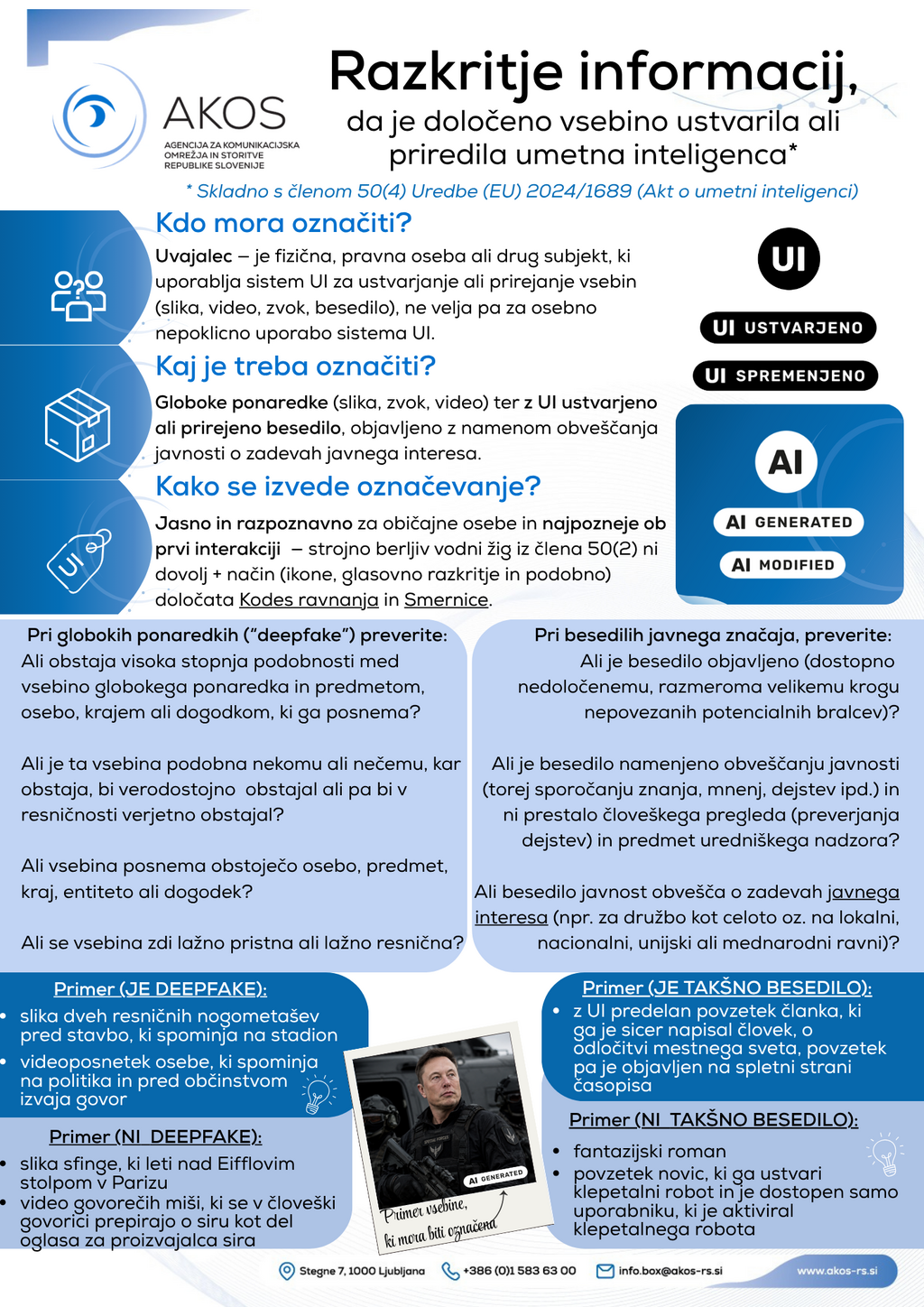
With the entry into force of the transparency obligations under Article 50 of the Artificial Intelligence Act (hereinafter: the AI Act), specific requirements binding on AI system operators came into force on 2 August 2026. They must disclose information to the public and to individual users when certain content is generated or modified by AI. The Agency, as one of the market oversight bodies and a point of contact for the AI Act, explains the key requirements.
Who is subject to these obligations and why
The obligations set out in paragraph 4 of Article 50 of the AI Act do not apply to developers and providers of AI systems, but exclusively to AI system operators — that is, those legal or natural persons who use AI systems professionally for business purposes (commercial interest). Situations may also arise where the AI system provider is simultaneously the AI system implementer, and consequently must fulfil dual obligations (as an example, consider a company that ‘refines’ an existing system and develops its own AI solution, then uses the outputs of its tool to create deepfakes). The obligation therefore arises at the point when a company, organisation or natural person carrying out a professional activity actually uses the UI system and disseminates its content to the public. On the other hand, the labelling obligations do not apply to any users who, as natural persons, use AI systems in the context of purely personal, non-professional activities.
The labels technically embedded into the content by the AI system provider in the form of a machine-readable watermark or a metadata entry (pursuant to paragraph 2 of Article 50 of the AI Act) are not sufficient to fulfil the obligations under paragraph 4, therefore, users cannot rely solely on the fact that the disclosure in the metadata or watermark itself is immediately apparent to an ordinary user without technical aids. Consequently , content creators must themselves ensure appropriate labelling and disclose, in a clear and recognisable manner, that the content has been created or adapted using AI tools. Furthermore, the disclosure must comply with the rules on accessibility for people with disabilities, as set out in the Act on the Accessibility of Websites and Mobile Applications and the Act on Access to Products and Services for Persons with Disabilities.
The purpose of these requirements is clear – to prevent misleading practices and thus ensure that individuals know when they are exposed to content generated using AI. On 20 July 2026, the European Commission adopted Guidelines on the implementation of transparency obligations for certain AI systems under Article 50 of the AI Act (C(2026) 5054), which interpret and specify the requirements. In parallel , a Code of Conduct on the transparency of AI-generated content was also adopted , endorsed by the European Commission and the AI Board.
Deepfakes: disclosure is mandatory
The first obligation under paragraph 4 of Article 50 of the AI Act concerns deepfakes — AI-generated or manipulated visual, audio or video content that mimics existing persons, objects, places, entities or events and which would falsely lead a person to believe it is authentic or real.
For content to be defined as deepfakes, four criteria must be met simultaneously: the content must be perceptibly similar to an existing subject; that subject must be real or plausibly existent (it exists or is likely to exist), it must imitate an existing person, object, place, entity or event, and the content must appear deceptively authentic or real to the user. It is essential that the assessment does not depend on the publisher’s intent — what is crucial is the objective capacity of the content to mislead. The assessment is carried out by the publisher themselves on a case-by-case basis. In doing so, they must pay particular attention to the impact on vulnerable audiences: children, older people and those with lower levels of digital literacy, for whom the risk of being misled is greater.
For content to fall within this definition, it must be created in a professional context. Private, non-professional use of the AI system is excluded from the scope of application, as is content that is legally permitted for the purposes of detecting, preventing, investigating or prosecuting criminal offences.
Providers must clearly and recognisably disclose the artificial origin of the content to the persons concerned by means of a visual or audible label. To this end , the European Commission has developed freely accessible EU icons for labelling content created or modified by AI — ‘AI GENERATED’ for content created entirely by AI and ‘AI MODIFIED’ for modified content. Providers who are required to comply with the Public Use of the Slovenian Language Act or the Consumer Protection Act when communicating with customers will have to ensure the linguistic version of the icon (the Slovenian icon) is appropriate themselves, as the European Commission has not published the official Slovenian versions of the labels. Operators who translate or create their own icons must also comply with the rules regarding appropriate font size, text layout, the size, positioning and contrast of the label itself, and other requirements set out in the Code of Conduct.
For content that forms part of a clearly artistic, creative, satirical or fictional work, a relaxed form of the obligation applies: disclosure is still mandatory, but may be carried out in a manner that does not detract from the experience of the work itself. The categories of such works are interpreted narrowly (for example, content of an informative or commercial nature, such as advertisements, cannot be classified under these exceptions).
Text created or adapted by a public service broadcaster in the public interest
The second obligation concerns published text that has been created or adapted using AI and is intended to inform the public about matters of public interest. The obligation arises when all three of the following conditions are met:
the text must be published — that is, accessible to an indeterminate, relatively large group of unconnected readers. Private correspondence, internal corporate communications and content in closed groups therefore do not trigger the obligation;
the text must be intended to inform the public, that is, to convey knowledge, opinions or facts. Mere advertising slogans or decorative text without any substantive message do not fall under this condition;
the text must address matters of public interest — areas that concern society as a whole and merit public debate: politics, democratic processes, public administration, the judiciary, public safety, public health, environmental and consumer protection, and economic and cultural development. This list is not exhaustive and may change over time.
Where all three conditions are met, the implementer of an AI system must clearly and recognisably inform readers of the artificial origin of the text — by means of a visible label, a statement (‘disclaimer’) or an equivalent method that can be detected without the need for specialised technical tools.
A practical exception to this obligation applies where both of the following conditions are met:
the text is subject to substantive human review or editorial oversight (including fact-checking) and, at the same time,
a legal or natural person bears editorial responsibility for its publication (including by publishing that person’s publicly accessible contact details).
A mere grammatical or spelling check of texts is not sufficient, nor is the mere existence of an editorial policy without its actual implementation. The sequence of events is also important: where an AI system ‘intervenes’ in the text after editorial approval has already been granted, the exemption is invalidated.
The role of the code of conduct
Implementers who adhere to the Code of Conduct on the Transparency of Content Generated by AI, the adequacy of which has been confirmed in accordance with paragraph 7 of Article 50 of the AI Act, are presumed to comply with the transparency requirements. The Code sets out precise specifications for the design and placement of the icon depending on the type of content, as well as accessibility requirements in accordance with relevant standards. Providers who have not adhered to the Code must demonstrate compliance independently and by other appropriate means.
