
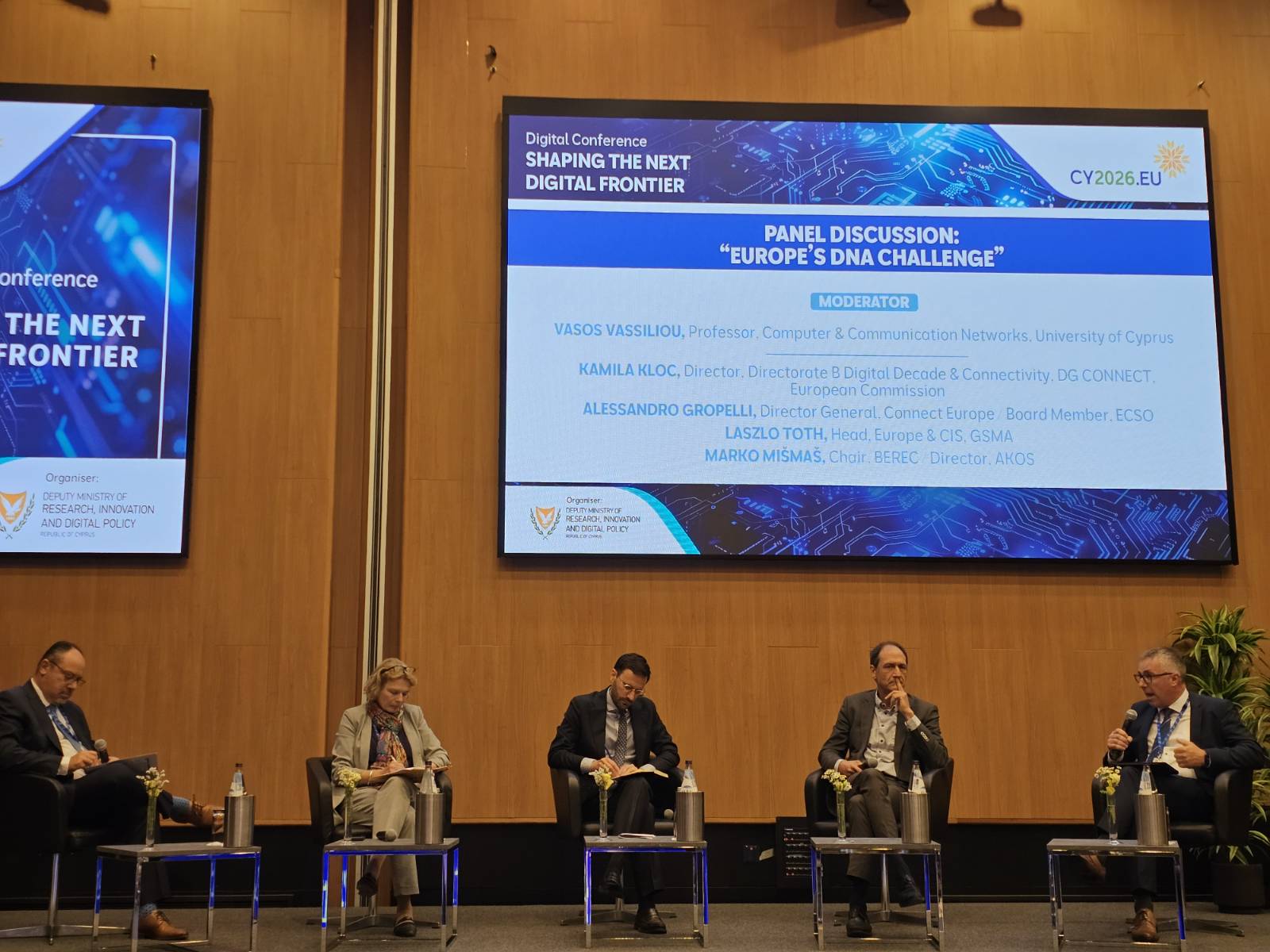
The Director of the Agency for Communication Networks and Services of the Republic of Slovenia (AKOS) and Chair of the Body of European Regulators for Electronic Communications (BEREC), took part in the two-day conference ‘Shaping the Next Digital Frontier’, organised by Cyprus as part of its Presidency of the Council of the European Union.
Speaking on the panel ‘The European Challenge of the Digital Networks Act’ (Europe’s DNA Challenge), which was dedicated to discussing the new European legislative framework for the future development of digital networks, he emphasised that the European framework for electronic communications has delivered significant results in recent years, including the development of very high-capacity networks, greater choice for users, more affordable services and more effective competition. The debate on the future regulatory framework should therefore not be based on the assumption that the current framework is not successful, but rather on the question of how to build on it.
“The aim must be development. Europe needs a framework that supports investment and innovation, whilst at the same time maintaining competition, user confidence and regulatory predictability,” emphasised Mišmaš.
He paid particular attention to the balance between simplifying the rules and maintaining effective safeguards. In his view, simplification is welcome when it reduces duplication, removes outdated provisions and enhances the clarity of the rules. However, this must not amount to either deregulation or the creation of new administrative burdens.
He also highlighted the importance of a balanced approach to the harmonisation of rules: ‘Common European rules can bring benefits where differences between countries create unnecessary barriers or uncertainty, for example in procedures, common methodologies, security, resilience and cross-border issues. At the same time, national regulators must retain sufficient independence to take account of the actual circumstances in individual markets. Effective regulation requires both European coordination and national expertise in the markets,” he said.
In the discussion on investment, he pointed out that investment and competition are not conflicting objectives. In his view, sustainable investment is strongest in an environment where the rules are predictable, competition is effective, and users are adequately protected. Connectivity is no longer merely an economic issue, but a fundamental prerequisite for inclusion in modern society and for the functioning of public services, industry, education and the digital economy.
A significant part of the discussion was also devoted to the role of networks as strategic infrastructure for artificial intelligence, cloud services, public services, industry and emergency response. “Networks are no longer merely infrastructure for connectivity. They are becoming the strategic foundation of the European digital economy, the development of artificial intelligence and societal resilience. This is also changing the role of regulators, who will need to pay even greater attention to resilience, security and systemic risks in future, whilst maintaining their core tasks: promoting competition, protecting users and supporting effective investment,” Mišmaš added.
