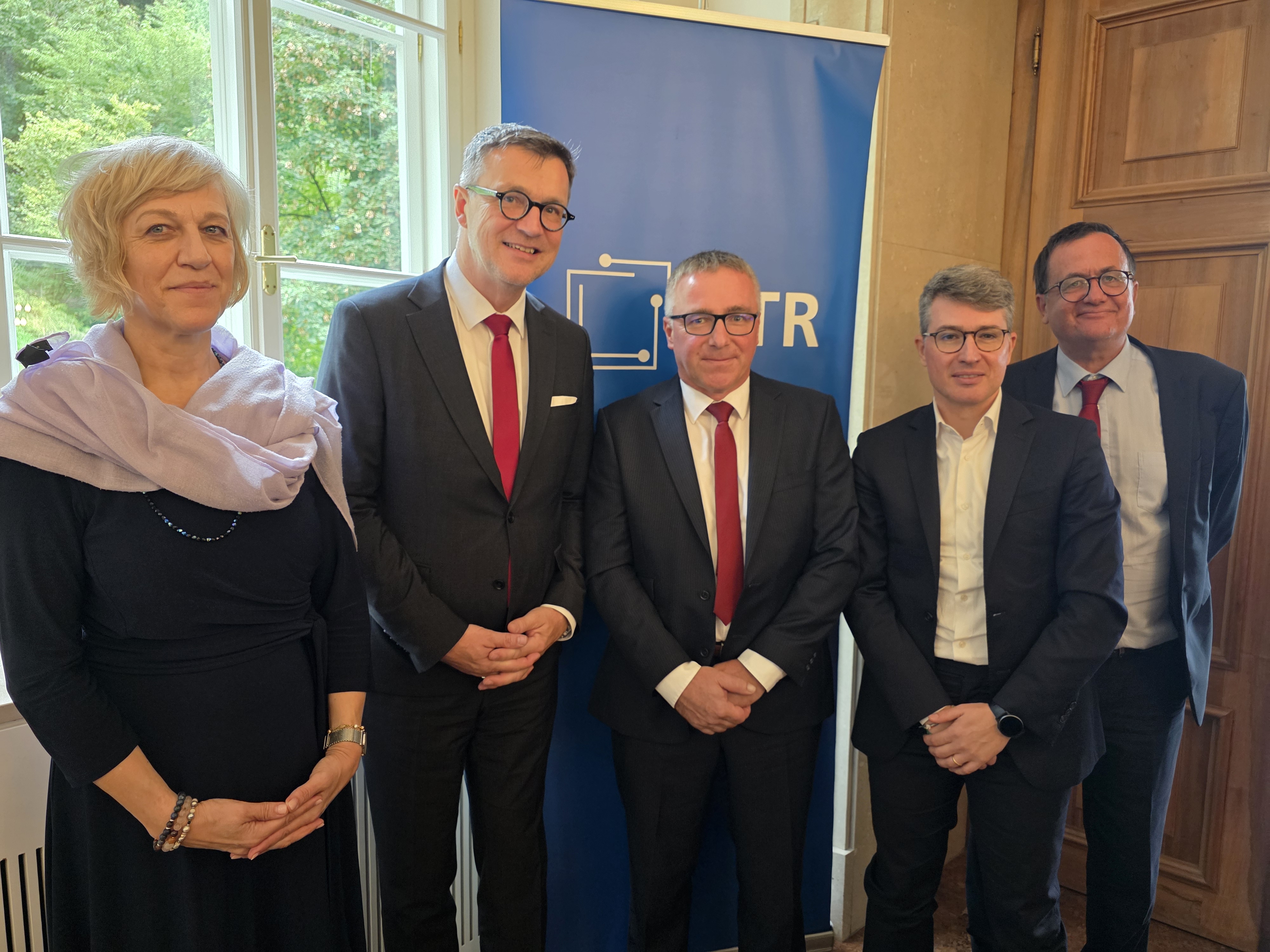
"The Digital Networks Act (DNA) represents an important opportunity to modernise the European regulatory framework for connectivity, but simplifying the rules and encouraging investment must not come at the expense of competition, consumer protection and regulatory predictability”. This was emphasised at the 27th Telecommunications Forum in Salzburg by the Director of the Agency for Communication Networks and Services of the Republic of Slovenia (AKOS) and Chair of BEREC, Mag. who presented the views of the Body of European Regulators for Electronic Communications (BEREC) on the DNA proposal.
BEREC supports the fundamental objectives of the proposal – simplifying regulation, increasing investment, strengthening competitiveness and resilience, and creating a more connected single market. Europe needs substantial investment in digital infrastructure capable of supporting an increasingly digitalised economy, the Internet of Things (IoT), cloud services and data centres. However, BEREC points out that less regulation does not, in itself, necessarily mean more investment.
“BEREC does not view competition and investment as conflicting objectives. Competitive pressure has historically been one of the main drivers of investment in networks and innovation in the European telecoms sector. We must ask ourselves how to ensure effective and sustainable investment whilst maintaining the competitive dynamics that drive innovation, quality and investment in new infrastructure,” said Mišmaš.
BEREC therefore proposes that competition remain a standalone regulatory objective, whilst the concept of efficient investment be explicitly retained amongst the objectives of the future regulatory framework. Regulatory predictability is also important, as operators make investment decisions over long time horizons. At the same time, BEREC supports the simplification of the European regulatory framework, but emphasises that it must be assessed on the basis of its actual effects.
It highlighted three areas where striking the right balance will be particularly important: the transition from copper to fibre-optic networks, the security of electronic communications networks, and the radio spectrum.
Regarding the transition from copper to fibre, BEREC welcomes the fact that the DNA proposal assigns an active role to Member States and national regulatory authorities and takes into account the fact that European countries are at very different stages in the transition to fibre. However, it has reservations regarding the envisaged unconditional phase-out of copper networks after 2035. If adequate fibre-optic coverage or another suitable alternative were not yet available by then, such an approach could have a negative impact on users and competition and, rather than reducing the digital divide, could even widen it.
“The phasing out of the copper network must encourage the construction and use of fibre-optic networks, rather than becoming an end in itself, detached from the actual situation regarding connectivity,” emphasised Mišmaš.
On network security and the proposed revision of the Cybersecurity Act (CSA2), BEREC supports strengthening the security and resilience of electronic communications networks and addressing geopolitical risks in ICT supply chains. However, measures must be realistic, proportionate and feasible. The premature mandatory replacement of equipment from high-risk suppliers that has not yet reached the end of its technical or economic life could result in very high costs. This is because the funds earmarked for replacing equipment that is still operational cannot be invested simultaneously in new fibre-optic networks, advanced 5G or future technologies.
The third area is the radio spectrum. Mišmaš emphasised the central role of the Radio Spectrum Policy Group (RSPG), whilst BEREC contributes its expertise primarily where spectrum issues are directly linked to competition, investment and the powers of national regulators.
BEREC has reservations, in particular, regarding the proposal for spectrum usage rights of indefinite duration and their automatic renewal. In BEREC’s view, the available empirical data do not show a reliable link between longer-term rights and greater investment or better quality of service. As spectrum is a limited public resource, the possibility of its periodic review enables regulators to adapt to technological developments, market changes and the entry of new providers.
In conclusion, Mišmaš emphasised that BEREC views the Digital Networks Act as an important opportunity. However, the success of the new legislation will depend on whether individual measures actually achieve, in practice, the objectives for which they were introduced.
“Let us simplify where simplification brings real benefits. Let us harmonise where harmonisation creates added value. Let us strengthen investment incentives where they are supported by evidence. At the same time, let us preserve the competition, flexibility and regulatory predictability that enable European connectivity markets to develop further. If we strike the right balance, the DNA will indeed be a better regulatory framework,” concluded Mišmaš.
