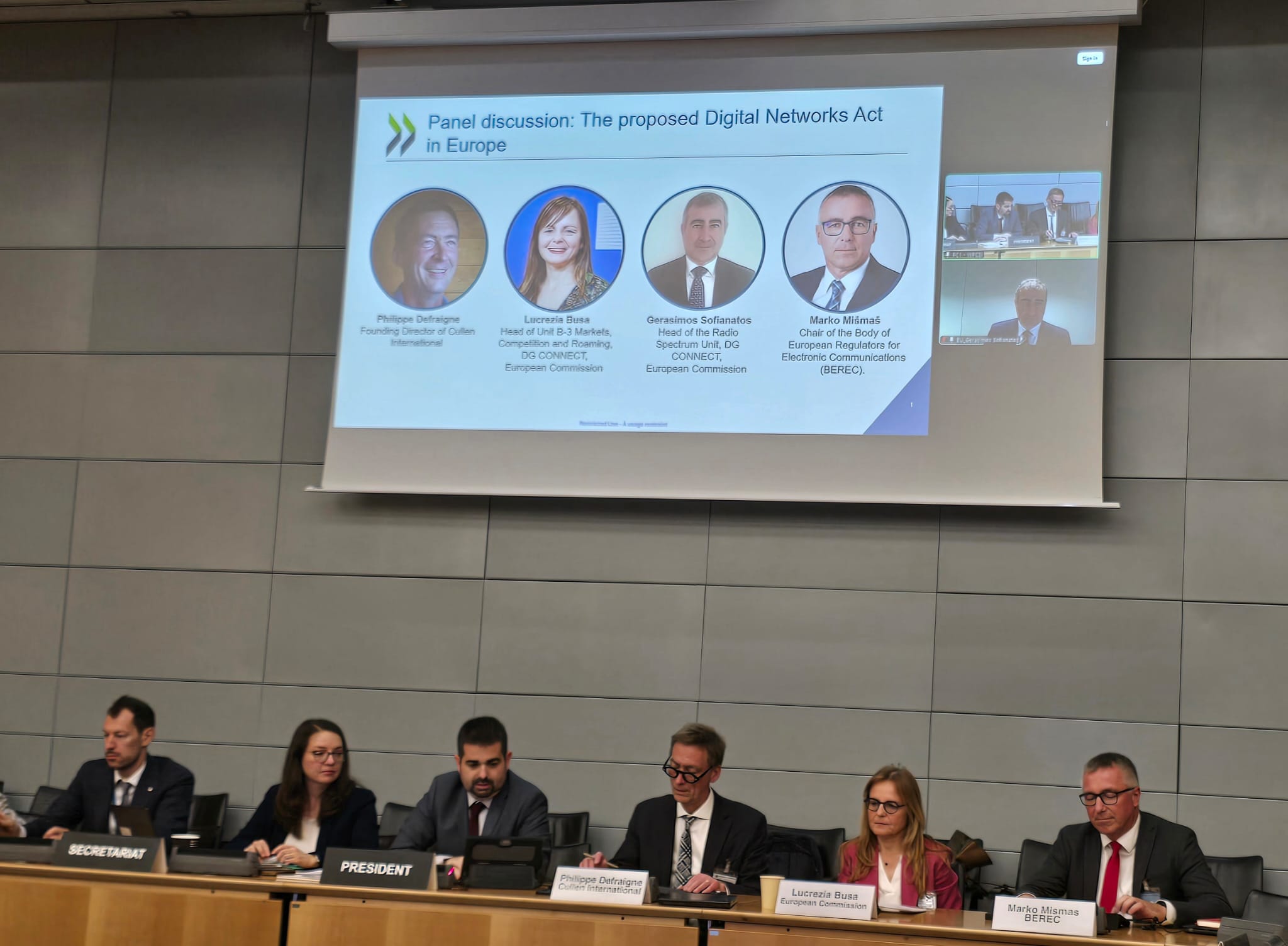
Director of the Communications Networks and Services Agency of the Republic of Slovenia and Chairman of BEREC mag. Marko Mišmaš participated today in a panel discussion entitled "The proposed Digital Networks Act in Europe" in Paris. The discussion took place in the framework of the OECD Working Group on Connectivity Services and Infrastructure, which acts as a forum for the exchange of experiences, best practices and discussion on policy and regulatory developments in the area of communications infrastructures and connectivity.
During the discussion, Mr Mishmash, the Agency's Director, presented the European regulators' perspective on the proposed Digital Networks Act, published by the European Commission with the aim of modernising, simplifying and harmonising the European regulatory framework for connectivity networks. He stressed that Europe's transition to full fibre connectivity is crucial for its digital competitiveness, resilience and strategic autonomy.
"It is essential that future regulatory solutions simultaneously encourage investment, safeguard effective competition and protect end-users. At the same time, simplification of rules should not weaken regulatory tools where they are still needed to address market problems", said Mr Mišmaš.
The resilience of electronic communications networks was also part of the discussion, with speakers stressing the importance of cooperation between regulators, operators, security authorities, civil protection authorities and other relevant institutions. In this context, the Director of the Agency, Mr Mišmaš, presented the Slovenian experience and the role of our Agency as an institution that has a good knowledge of the national communication infrastructure and can contribute to the effective integration of the relevant stakeholders.
In this context, Mr Mišmaš highlighted the European ENDURANCE project in which the Agency participates. The project aims to strengthen the resilience of Europe's critical infrastructures and to improve cooperation between different sectors and countries to prevent, manage and recover from major disruptions, including physical and cyber incidents. The project aims to keep essential services up and running in crisis situations.
Other topics discussed included: access to network infrastructure, the transition from copper to fibre networks, spectrum policy, network security and the involvement of regulators in the wider digital ecosystem.
The OECD, or Organisation for Economic Co-operation and Development, is an international organisation or forum for public policy-making that enables countries to share data, analysis and good practice. It works with more than 100 countries around the world to shape better policies, especially in the economic sphere.
