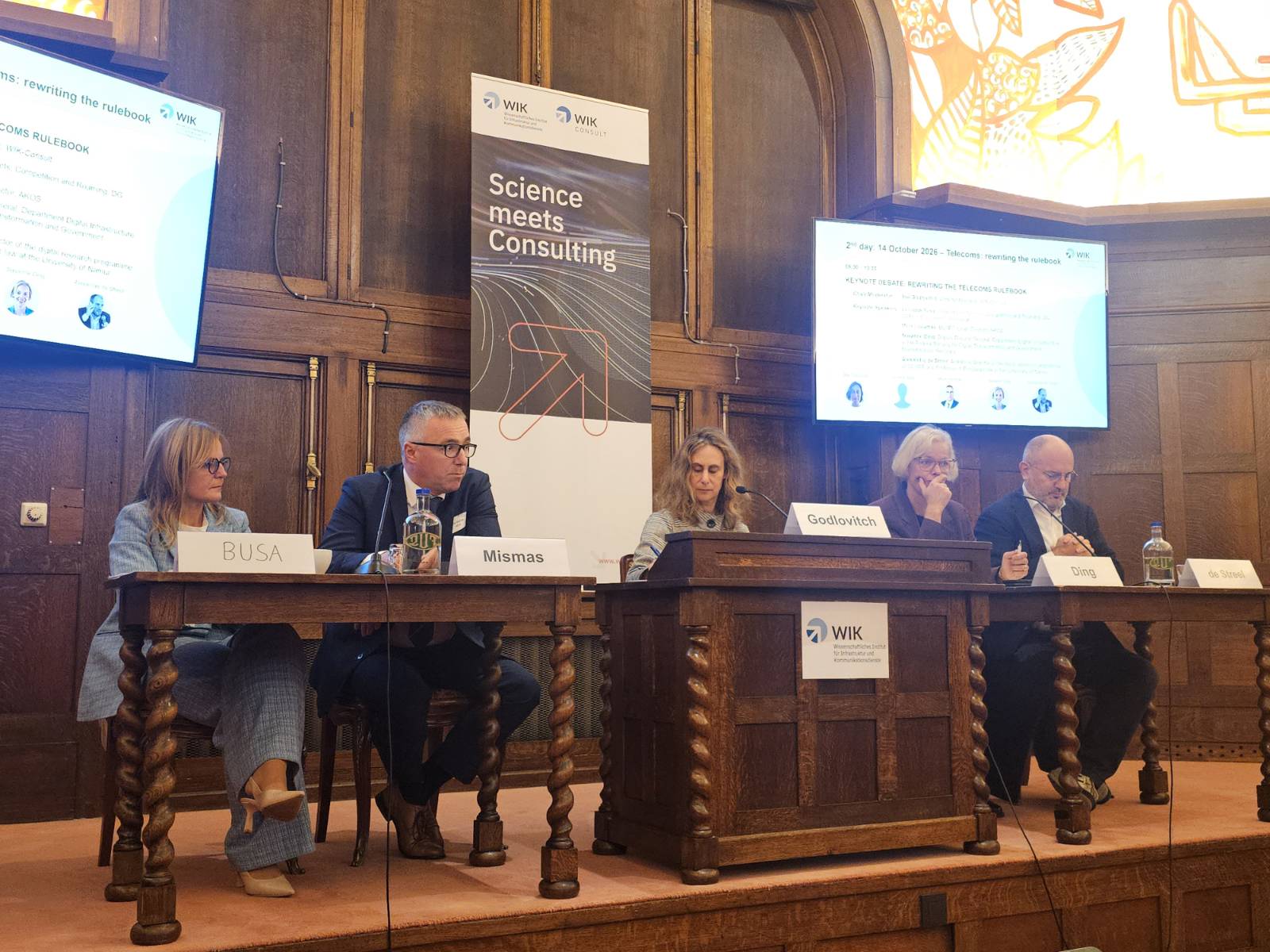
Future European rules on digital networks must maintain competition as an objective in its own right, whilst assessing investments on the basis of the benefits they bring to people and businesses. This was emphasised at the annual WIK conference by Marko Mišmaš, Director of the Agency for Communication Networks and Services of the Republic of Slovenia (AKOS) and Chair of the Body of European Regulators for Electronic Communications (BEREC) in 2026.
The conference, which took place in Brussels on 13 and 14 October 2026, brought together representatives of European Union institutions, regulators, industry and the academic community. The main discussion centred on the proposal for the Digital Networks Act (DNA). During the discussion, Mišmaš presented BEREC’s views on the objectives of the future regulatory framework, technological neutrality, the transition from copper to fibre-optic networks, mobile connectivity, radio spectrum and the management of telecoms markets.
He welcomed the greater emphasis the proposal places on European competitiveness. At the same time, he pointed out that competitiveness in the telecommunications sector is not the same as competitiveness in the European economy as a whole. Connectivity is a fundamental service for manufacturing, transport, healthcare, financial services and small and medium-sized enterprises; therefore, its price, quality and availability are also important outside the telecommunications sector.
“Competition in the European telecoms sector has contributed to lower prices, better quality, greater choice and the promotion of innovation and investment. BEREC therefore proposes that, in the future regulatory framework, it should remain an independent regulatory objective and not merely one of the tools for achieving competitiveness. In BEREC’s view, competition and investment should not be treated as conflicting objectives, as they can reinforce one another,” said Mišmaš.
This view is also supported by BEREC’s recent comparative analysis of European telecoms markets, which paints a more balanced picture of the European sector than is often portrayed in public debates. Whilst acknowledging the achievements, BEREC also highlights areas where further progress is needed, including network speeds, the use of advanced connections and the reduction of the digital divide.
The aim should be high-capacity networks, not a specific technology
Fibre-optic networks are crucial to Europe’s digital future, but, according to Mišmaš, their development is not in itself a reason to abandon the principle of technological neutrality. When defining gigabit networks, the framework should focus on actual capacity, reliability and quality of service. This preserves scope for new technologies and different solutions depending on the circumstances in individual areas.
“The transition from copper to fibre-optic networks must also be predictable and aligned with actual conditions. The phasing out of the copper network does not mean that bottlenecks or the need for access automatically disappear. Regulation must therefore continue to be based on market analysis: measures must be maintained where there are competition issues, and reduced or removed where the market is functioning effectively,” emphasised Mišmaš.
In the case of mobile networks, data on 5G coverage alone does not indicate what speeds are actually available to users. Future European targets must therefore monitor not only coverage but also performance, reliability, capacity and quality of service. The targets must be ambitious, yet also measurable and based on what the networks actually deliver.
Mišmaš also advocated for European coordination of radio spectrum policy that delivers clear added value, whilst taking into account the differences between national markets. Long-term predictability is important for investment, but in BEREC’s view it does not require permanent rights to use the spectrum. Rights with no time limit may restrict the entry of new providers and the ability to adapt to future technological and market changes.
Spain’s experience with the transition to fibre optics
Alejandra de Iturriaga Gandini, the incoming BEREC Chair for 2027 from the Spanish regulator CNMC, presented Spain’s experience with the roll-out of fibre-optic networks and the phasing out of the copper network. According to OECD data, by the end of 2024, fibre-optic networks accounted for 89 per cent of all fixed broadband connections in Spain. This development was driven by early investment, wholesale agreements, public funding for rural areas, access regulation and a smooth transition of users to the new networks.
